Seiko SARB033 review: the best watch you can no longer buy
After returning from Apple Watch to mechanical watches a year and a half ago and taking a basic watchmaking course, I bought my first higher-quality mechanical watch, the Junghans Max Bill Automatic.
I still enjoy the Junghans, but it is a dress watch suited to work and social occasions, so it saw less use during the pandemic. When the most you can do is walk in the woods, a more versatile or sporty watch makes sense.
Choosing and buying the watch
I looked for a versatile watch with a timeless dial that could appear elegant on a bracelet or leather strap and sporty on a colourful NATO strap. It naturally needed adequate durability in the form of a sapphire crystal and sensible water resistance—essentially something resembling a Rolex Explorer I at a substantially lower price.
After extensive research, the Seiko SARB033 emerged as the ideal choice. It is often described as a cheaper alternative to the Rolex Explorer I.
There was one fundamental problem: production ended in 2018, making a SARB033 difficult to buy by 2021.
The Seiko SARX035 is considered its successor. It looks very similar and is available locally, but costs around three times as much and, more importantly, is larger. A diameter of 40 mm is slightly too much for my small 16 cm wrist.
The answer was the secondary market. I found several examples within the EU on Chrono24—avoiding customs and VAT—with prices between €600 and €750. In the end, I was lucky: a 2013 SARB033 appeared on the Czech Chronomag forum for €499. I noticed the listing quickly enough and bought it.
Seiko SARB033
Seiko and the Japanese domestic market
The Japanese company Seiko hardly needs an introduction. Seiko has made watches since 1881 and achieved milestones including the first quartz watch and first quartz chronograph.
A less familiar fact is that some Seiko watches are intended only for the Japanese market and can be difficult to obtain elsewhere. They are described as JDM—Japanese domestic market—models.
Among JDM watches, you can often find models offering substantially higher quality than comparably priced Seiko products for international markets. They typically have better movements with improved accuracy and reliability as well as superior finishing.
The Seiko SARB033 belongs to this JDM category.
Design
A polished 38 mm steel case surrounds an elegant black dial with applied rectangular indices. Applied means that the hour markers are separate objects raised above the dial rather than simply printed onto it.
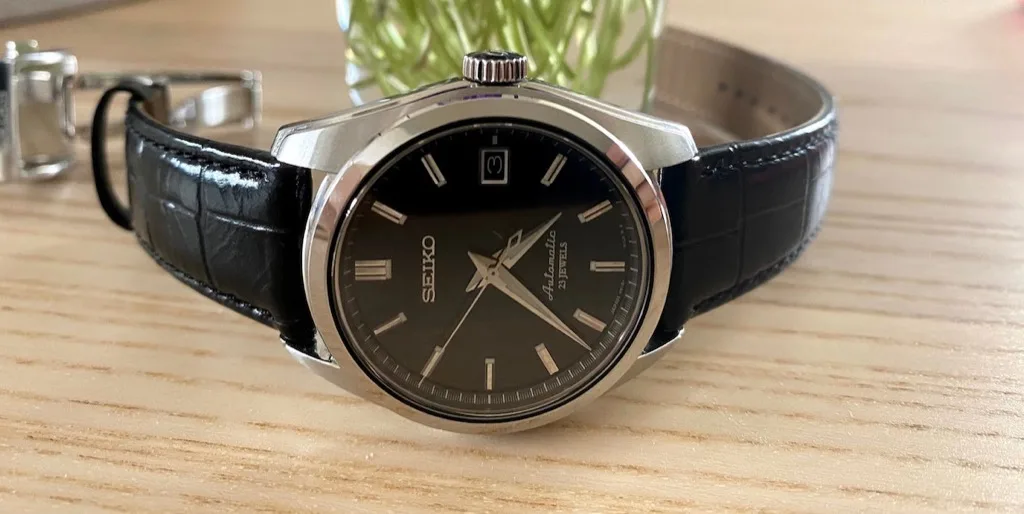
The Seiko logo is applied, while “Automatic” and “23 jewels” are printed in grey.
The hour and minute hands begin with a narrow base, widen rapidly and then taper gradually. The seconds hand resembles a sewing needle, complete with an eye near its base.
A date window sits at three o’clock. Its date wheel is black, a detail not always found on black dials, which commonly use a white date wheel.
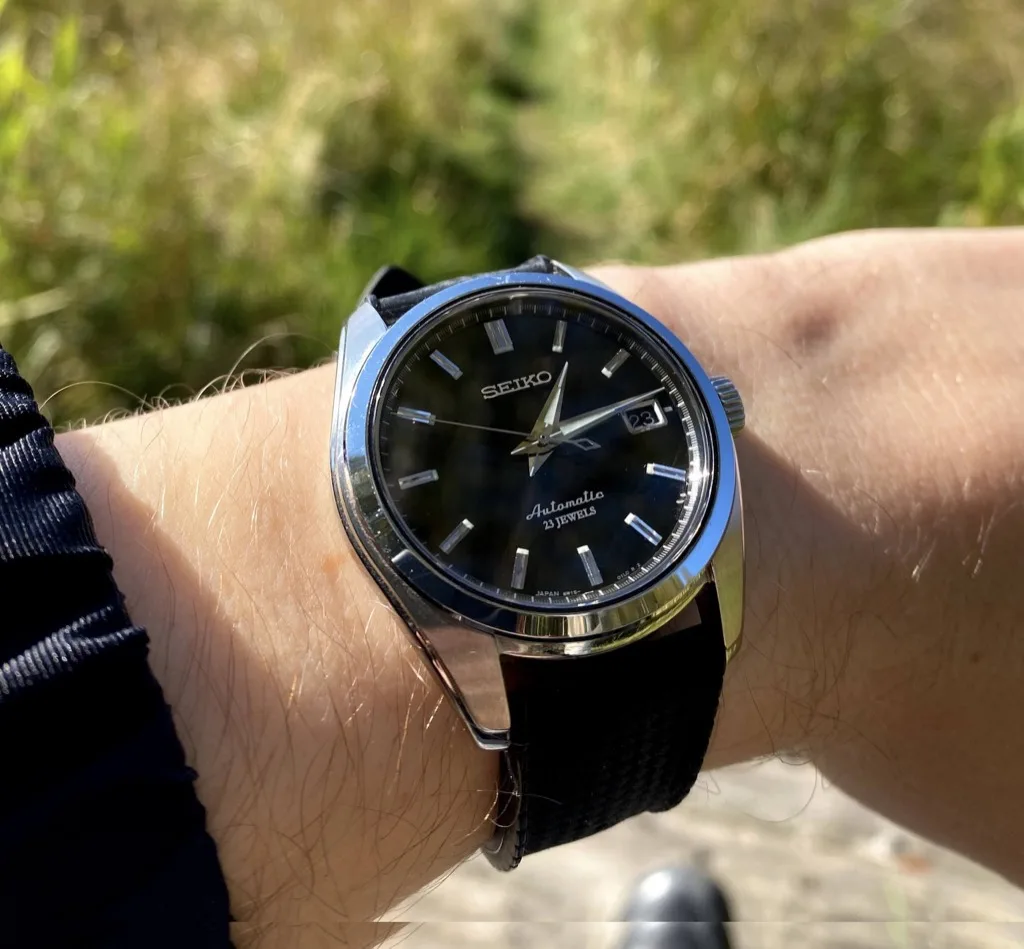
The inner minute track aligns precisely with the hour indices.
The crown also sits at three o’clock. It does not screw down, although the watch still offers 100 metres of water resistance. A beautifully engraved letter S decorates the crown—an uncommon detail at this price.
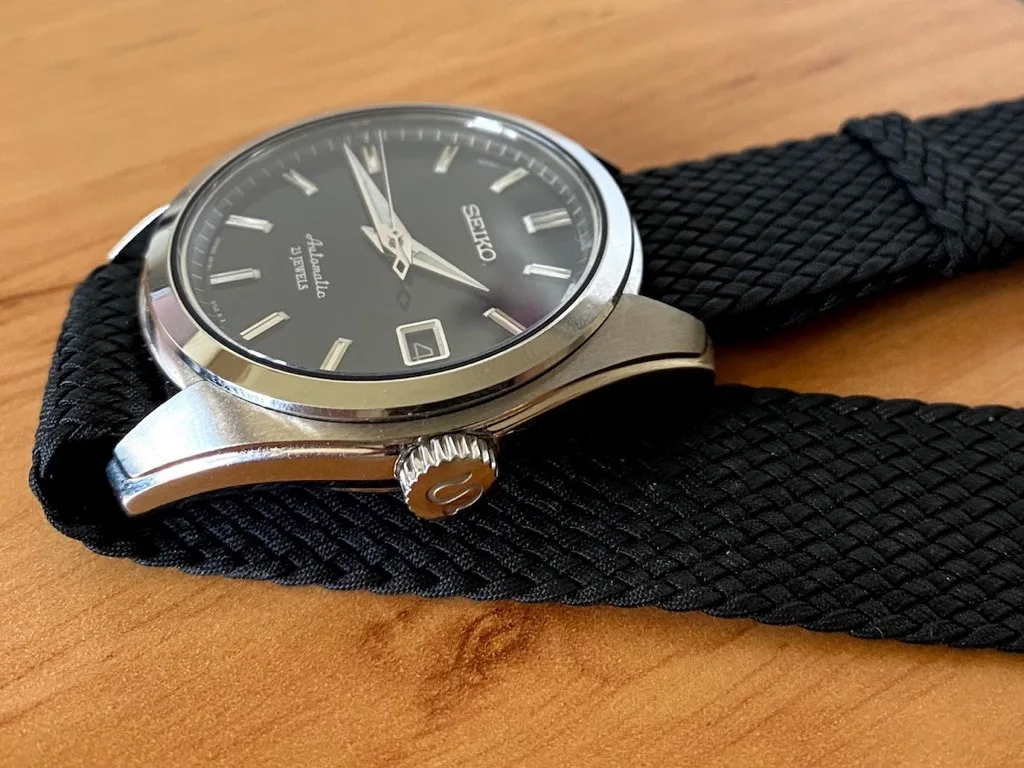
A sapphire crystal with an anti-reflective coating protects the dial. A transparent plastic crystal on the case back provides a view of the 6R15 movement.
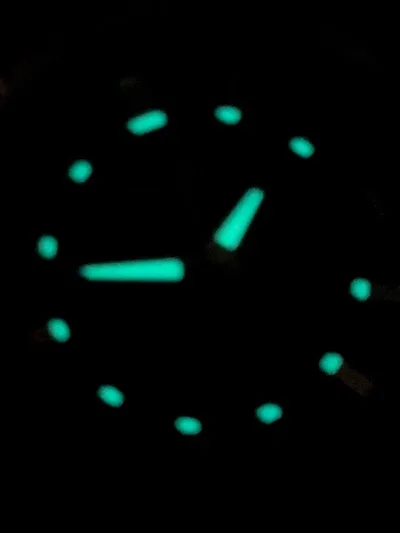
The lower portions of the indices and the centres of the hour and minute hands carry luminous material. In darkness, the missing marker at three o’clock, replaced by the date window, reveals the watch’s orientation.
Movement
The watch uses Seiko’s 6R15 movement, commonly associated with the Prospex range. Its specified accuracy is +25/-15 seconds per day, its power reserve is 50 hours and it runs at 21,600 vibrations per hour—six beats per second.
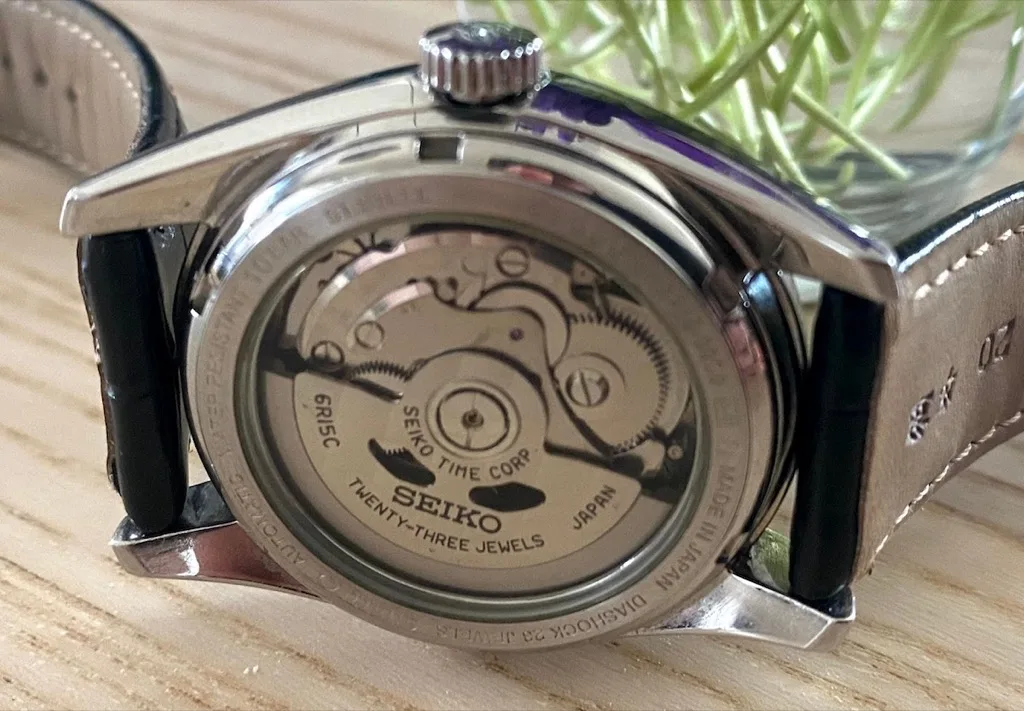
For comparison, ETA movements found in a great many watches today run at 28,800 vibrations per hour, or eight beats per second. A lower beat rate means fewer vibrations and potentially a longer interval between services, but also a less fluid sweep. In practice, I do not think you notice it.
Compared with the J800.1, a modified ETA 2824, inside the Junghans Max Bill Automatic, I could see no difference in the smoothness of the seconds hand. I could hear one when holding both watches to my ear.
The movement naturally supports hand-winding and hacking: pulling out the crown stops the seconds hand, allowing precise time setting.
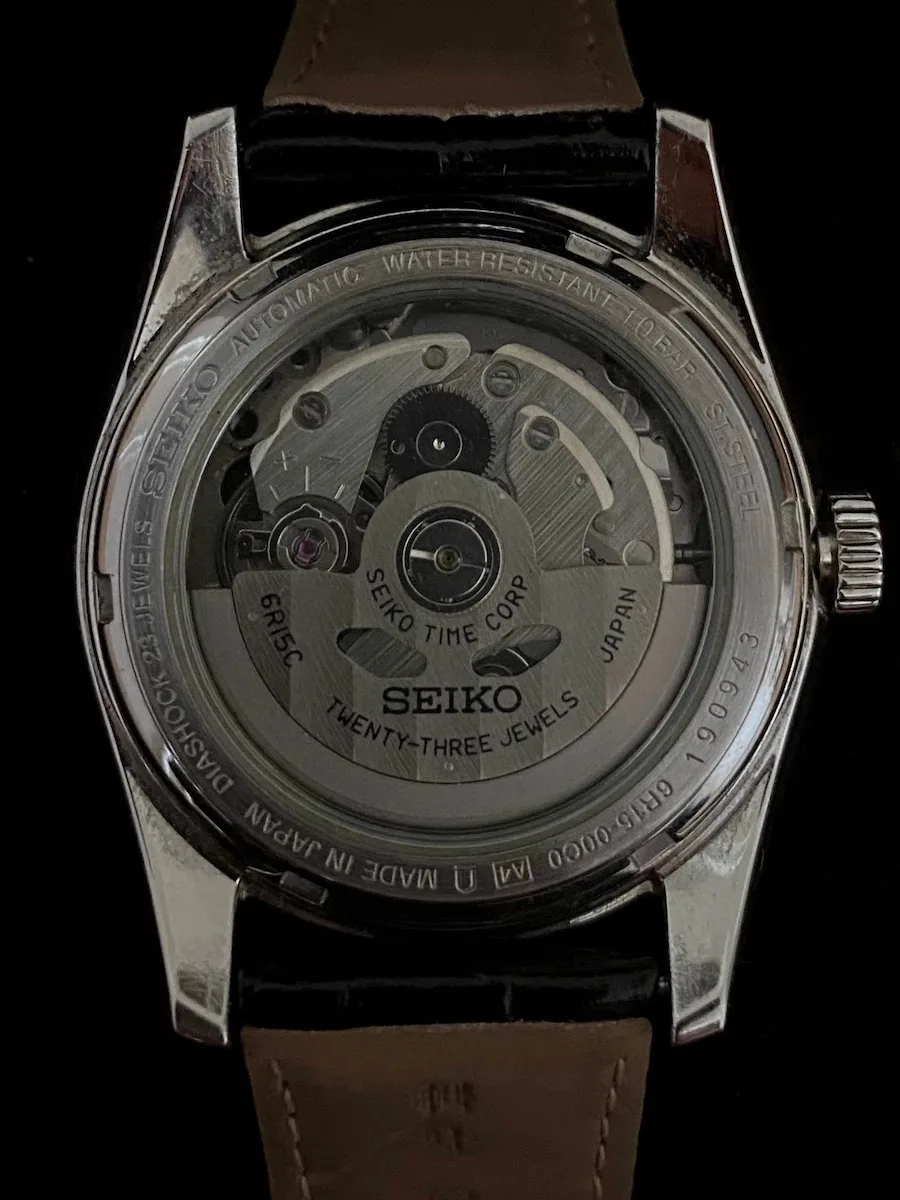
It is not decorated. Through the transparent case back, the only visible embellishment is a little Côtes de Genève on the rotor.
Wearing experience
The watch wears extremely well. Its 38 mm diameter is ideal for my 16 cm wrist. A lug-to-lug distance of only 44 mm also contributes to the comfort; this measurement is often more important than diameter itself.
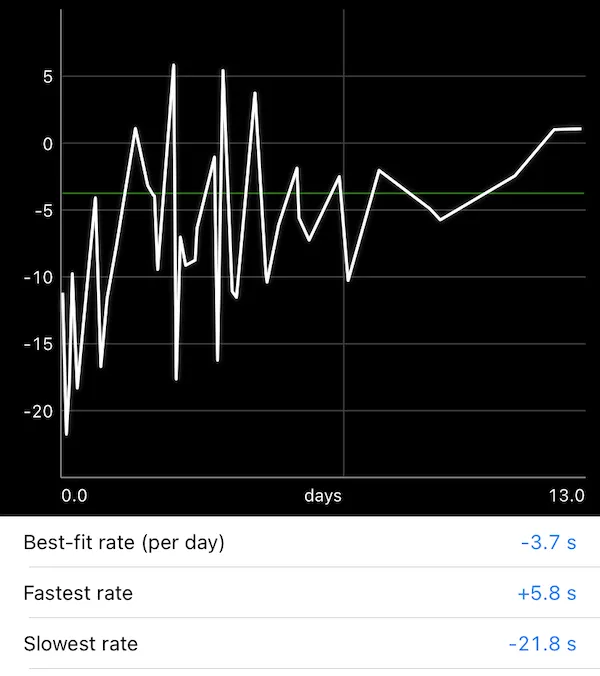
Mine lost just under four seconds per day, an excellent result for an eight-year-old movement that had never been serviced. Measurements showed that most of the loss occurred during daytime wear; lying on a table overnight, it ran almost exactly on time.
The SARB033 is noticeably heavier than the Junghans Max Bill Automatic, weighing almost twice as much. It is still not unpleasant or uncomfortable. Instead, it feels robust and inspires confidence during rougher use.
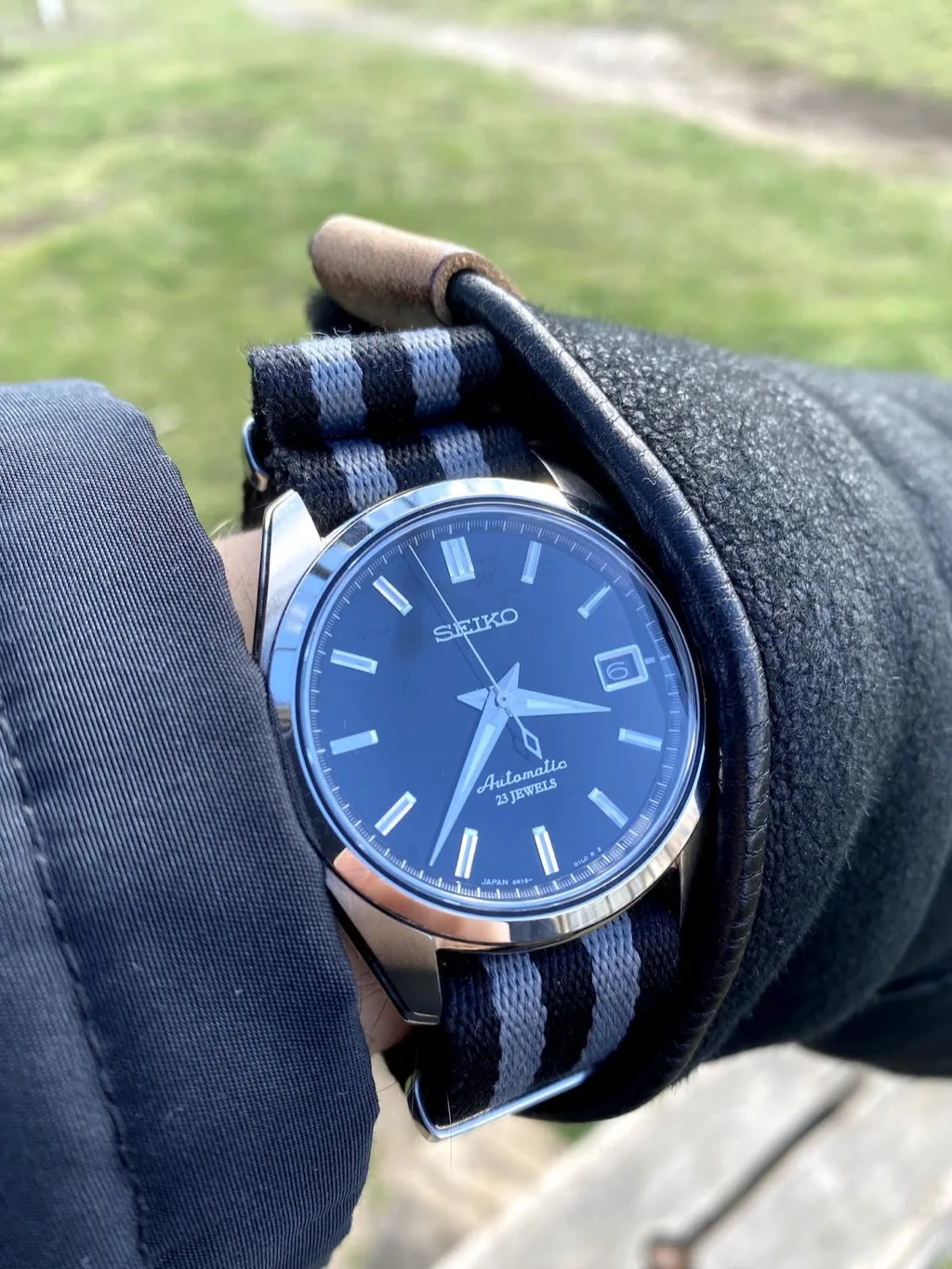
I wear it exclusively on a NATO strap, the most comfortable choice for me.
Specifications
| Case width | 38 mm |
| Case height | 11 mm |
| Strap width | 20 mm |
| Case material | Steel |
| Crystal | Sapphire |
| Movement type | Automatic |
| Movement | 6R15 |
| Power reserve | 50 hours |
| Accuracy | +25/-15 seconds per day |
| Water resistance | 100 metres |
| Weight | 72 g |
Conclusion
The Seiko SARB033 is an excellent all-purpose watch that, in my opinion, still has no worthy replacement. Its value for money is almost unbeatable, and at around €500 there is very little to criticize.