Taking a beginner's watchmaking course
Having recently become more seriously interested in mechanical watches, I decided to take a beginner’s watchmaking course. I found one at Království hodin in Prague that sounded interesting from its description.
The beginner’s course
The course was supposed to last three hours, from 6 pm until around 9 pm, with a small group of three people, for CZK 1,500. Its greatest advantage was that participants needed neither their own tools nor watches; everything was included.
Those conditions were much more appealing to me than courses requiring everyone to bring an old Prim watch bought second-hand and various other equipment.
Course content
Each participant received a workstation with prepared tools, a mat and a lamp. The watchmaker first described every tool and explained how to use it. He also told us where and at what price we could buy our own equipment.
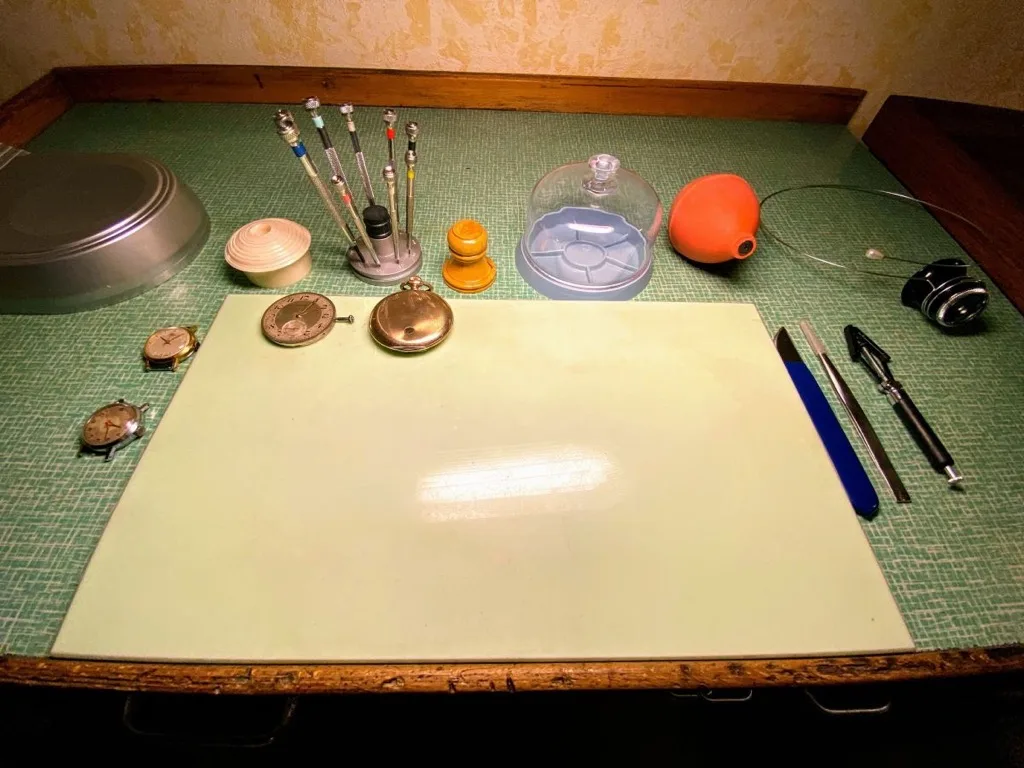
The course centred on disassembling and reassembling three watches: one pocket watch and two conventional Prim wristwatches.
We began with the pocket watch because it was larger. Mine had a subsidiary seconds hand, which also made things slightly easier.
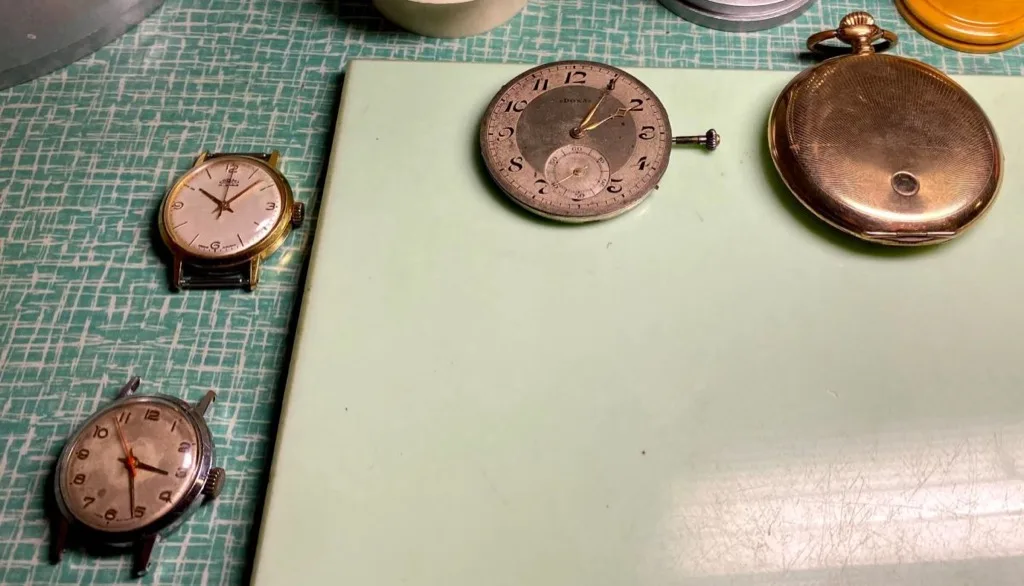
The first step was removing the case back. None of the watches had a screw-down case back of the kind found on modern watches, so opening them required a watchmaker’s knife and the correct technique to avoid scratches.
After opening a watch, we removed the stem—the continuation of the crown inside the watch—and, after loosening its screws, took the entire movement out of the case.
We then removed the hands and detached the dial from the exposed movement. Finally, we reassembled the watch completely.
The entire process was repeated with the other two Prim wristwatches, with small differences depending on their exact type.
My experience
Disassembling and reassembling the watches was not as difficult as I had expected. Some tasks, such as refitting the hands, nevertheless required considerable concentration and precision.
I also had a few mishaps. While removing the pocket watch’s seconds hand, it flew away and landed somewhere on the floor. The screws securing the dial on one wristwatch were so small that both sprang away as I tried to position them, and I lost them. The watchmaker had to help by fitting replacements.
Overall, however, it went well. With the right tools, I would certainly feel confident replacing the dial and hands on one of my Seiko watches. Trying a Seiko mod was one of my motivations for taking the course. I would definitely not attempt any work on my Junghans, however.
At the end, I immediately signed up for the more advanced course offered by Království hodin. It was intended to teach me how to disassemble and clean a watch movement.