What it is actually like to visit a maid café in Akihabara 🇯🇵
During my second trip to Japan, as an anime fan I naturally had to return to Akihabara and visit a maid café.
A maid café is a type of café where waitresses dressed in maid uniforms serve the customers. They treat guests with exaggerated respect, address them as “master” or “princess” and try to create a playful, slightly theatrical atmosphere. The experience includes making gestures together when food is served, having pictures drawn on an omelette and taking a photo with your favourite maid. Maid cafés are popular with anime and manga fans, but anyone looking for an unusual experience can visit one.
Choosing a maid café
There is a maid café on almost every corner in Akihabara, although the better-known ones are often full around lunchtime. This time, I chose @home cafe.
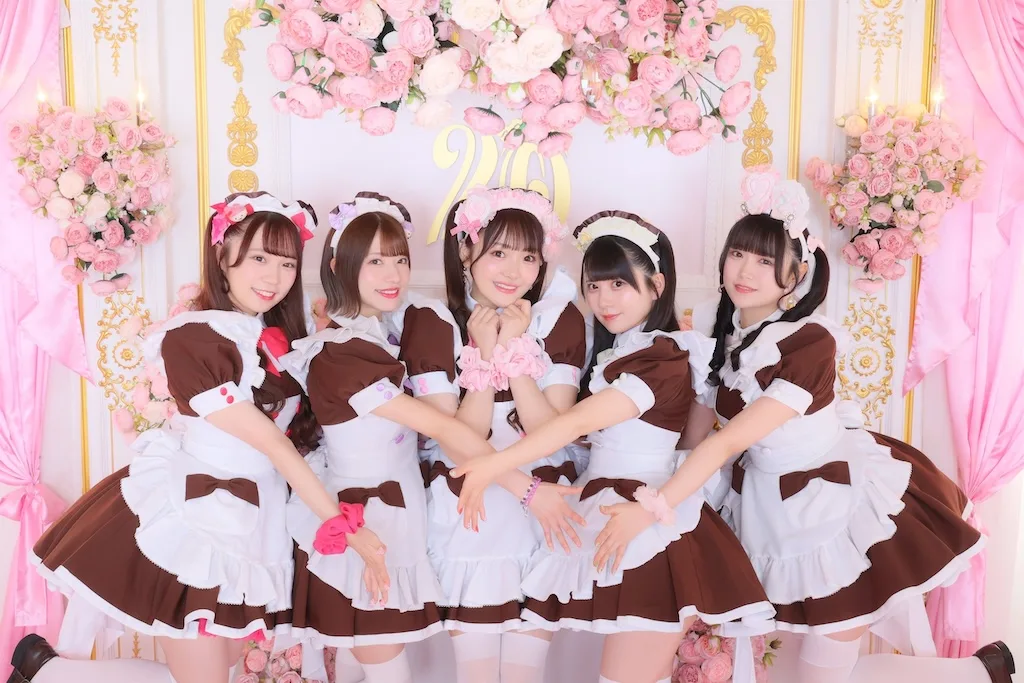
It occupies a seven-storey building, with each floor from the third upwards operating as a separate café under the same brand.
Waiting and entering
I went up to the third floor and joined the queue. After a while, an employee who was not wearing a maid uniform came out and asked me something in Japanese. I did not understand, so I simply replied that it was my first visit. She handed me a card in English explaining the café’s rules, prices and menu. One of the main rules was that photographs could not include any customers or maids.
After waiting for around 20 minutes, it was my turn. The door opened and I was welcomed by a rather tall Japanese woman in a maid uniform.
The welcome ritual and taking my seat
She asked whether I spoke Japanese. I replied that I spoke a little. As we entered the main room, she rang a bell and announced my arrival. The other maids turned towards me and all greeted me at once.
After I sat down, she introduced herself as きぬ and asked whether I preferred English or Japanese. When I replied in Japanese that English would be better, she apparently took it as proof that I was not merely pretending to speak Japanese and continued talking to me only in Japanese.
 |
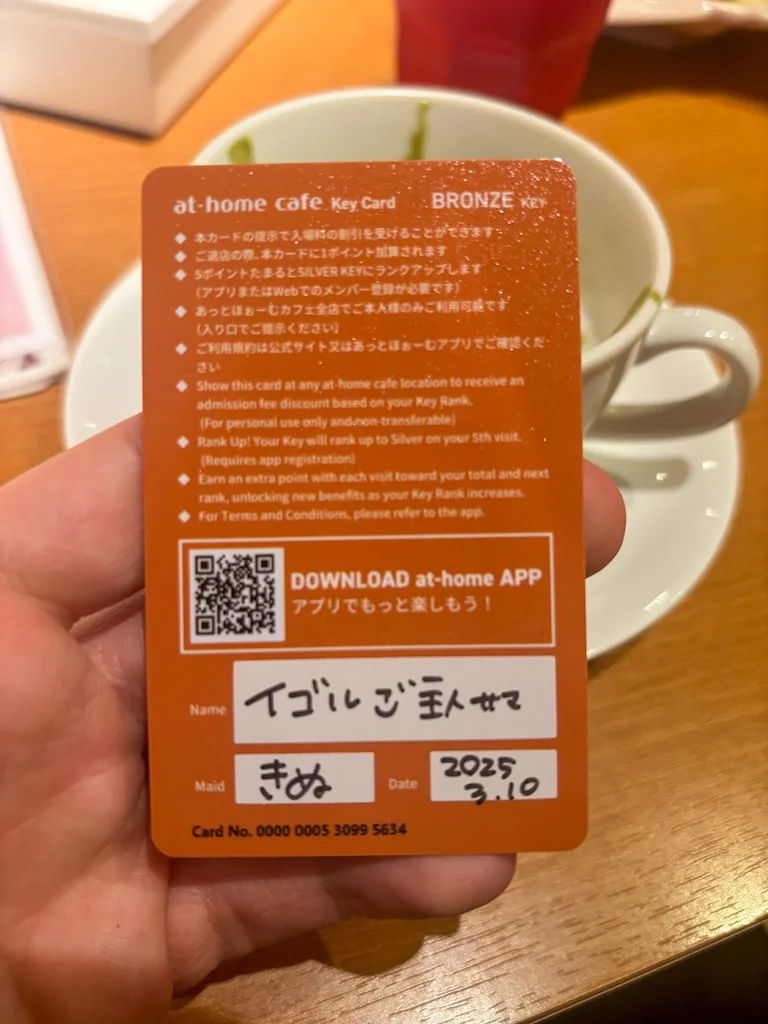 |
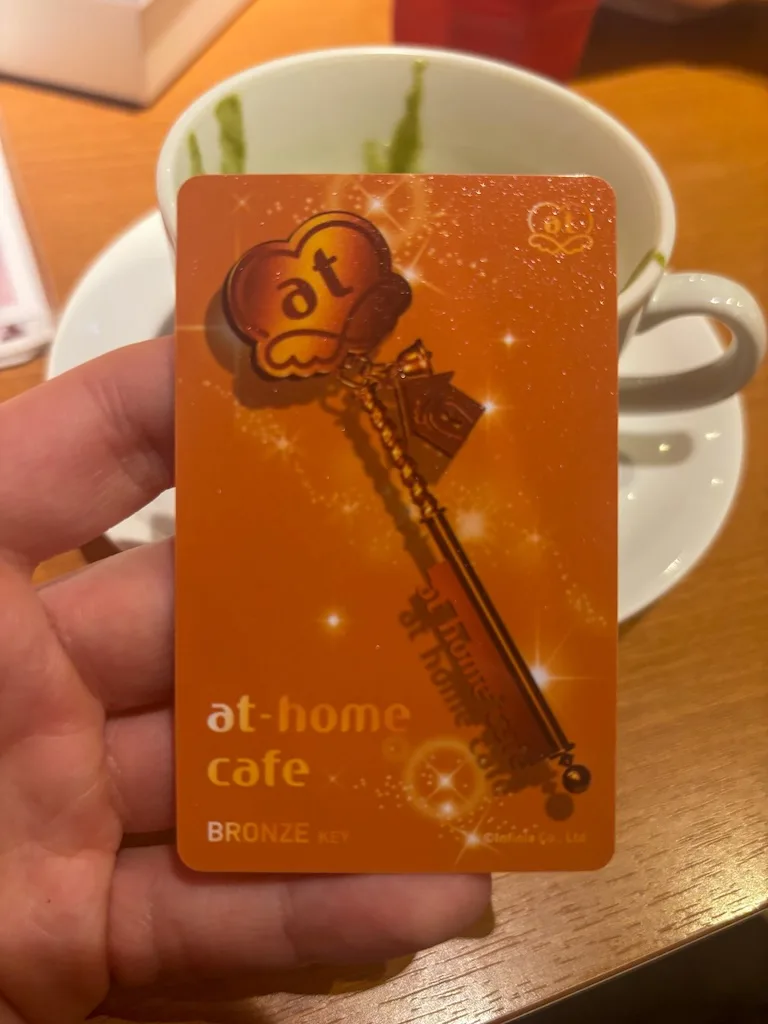
I received a loyalty card. きぬ asked for my name, I gave her its Japanese version and she wrote it in katakana.
Ordering and the experience at the table
She recommended something from the menu and read a text from an envelope about how she would do everything she could to make me happy. I did not understand all of it, but I got the general idea.
Visiting the maid café required ordering at least one drink and paying an hourly entrance fee of around ¥700. I chose a package that included a drink and meal of my choice, a photo with my favourite maid and a souvenir album for the photo.
For my drink, I ordered a hot matcha latte. For the meal, I chose オムライス (omurice), a Japanese omelette with rice.
きぬ complimented my Japanese and asked whether it was my first time there, whether I lived in Japan, when I had arrived and how long I was staying. Fortunately, I understood everything and could answer.
She then brought me a catalogue of the maids and asked which one I wanted to take a photo with. I did not even open it. I immediately said that I wanted a photo with her.
Food and drink
After a while, another maid brought my matcha latte and asked what she should draw on it. I asked for a cute animal, so she drew a cat.
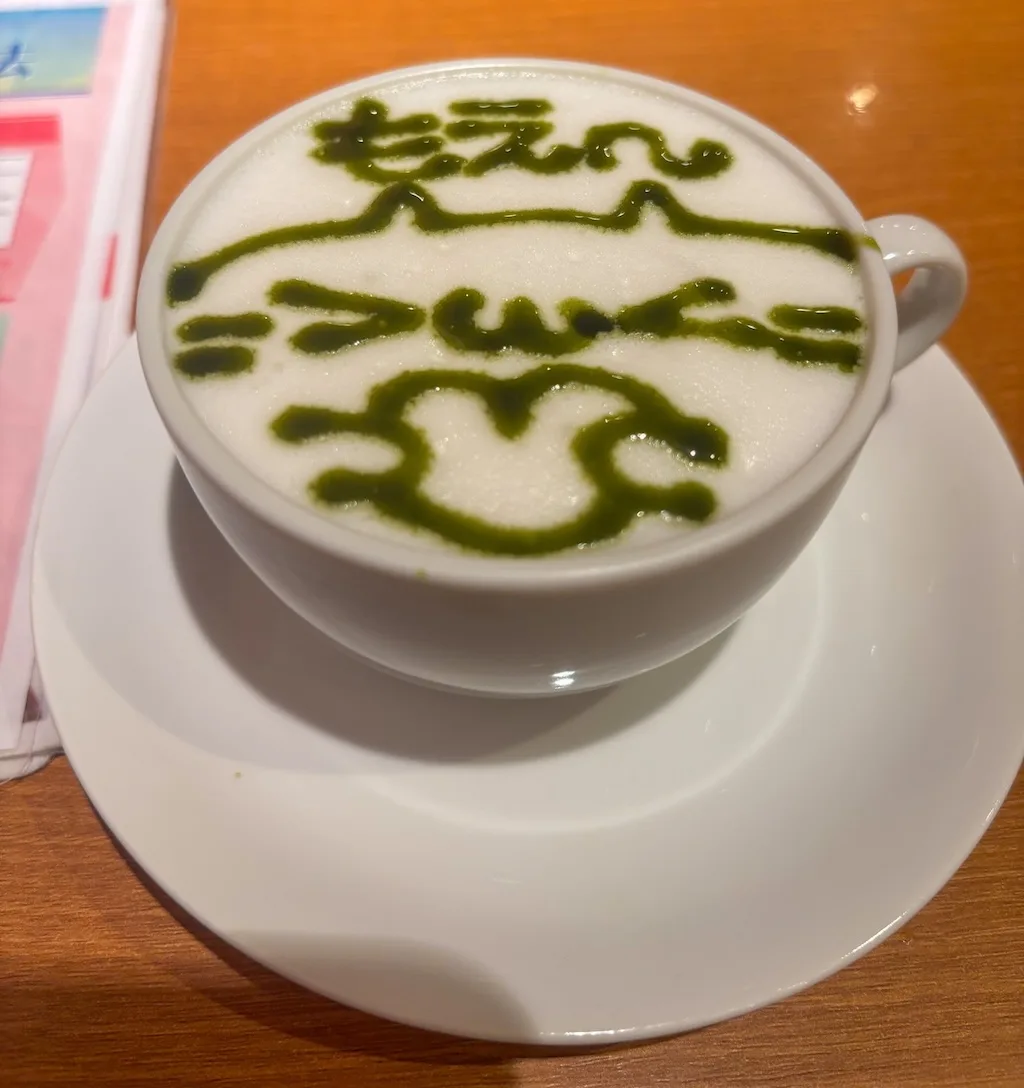
Then came the classic ritual: the maid and I had to make gestures with our hands and say “moe moe kyun” together.
The オムライス arrived a little later, followed by the same question. Since I already had a cat on my matcha latte, I asked for another one. Then we performed the “moe moe kyun” ritual again.
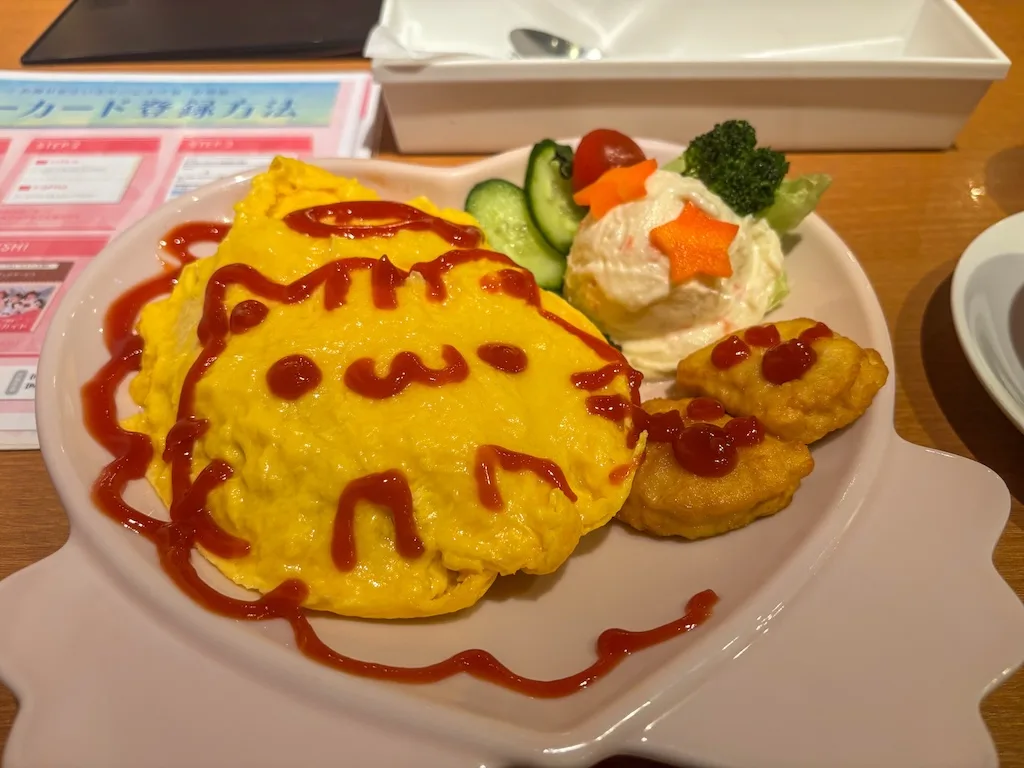
Up to this point, the experience had been enjoyable. It was new, interesting and generally felt well done.
The omelette itself was not particularly good. But nobody really goes to a maid café for the food.
Observing the atmosphere
While eating, I watched the other customers having their photos taken. The café was not filled only with men or tourists. There were also Japanese girls in school uniforms who were clearly high-school students. Apart from me, the only foreigners were a group of four Americans. Everyone else was Japanese.
Once I had finished eating, however, I became bored. There was nothing to do, so I simply waited for the photo session. It took around half an hour, and this long period of waiting significantly diminished the overall experience. I did not see a live performance either.
If the photo had been taken earlier and I could have left immediately afterwards, the experience would certainly have been better.
Taking a photo with a maid
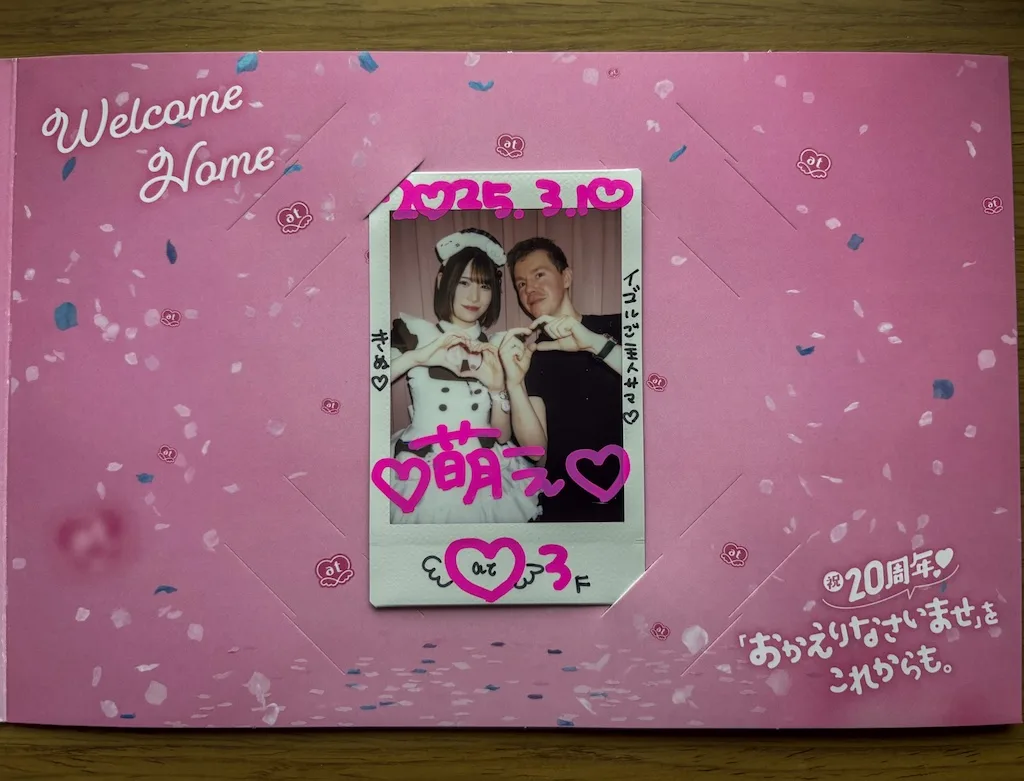
Half an hour later, きぬ appeared on the stage, announced my name over the microphone and invited me up. She offered three different poses and recommended one, so I followed her advice. The photo was taken with an Instax camera.
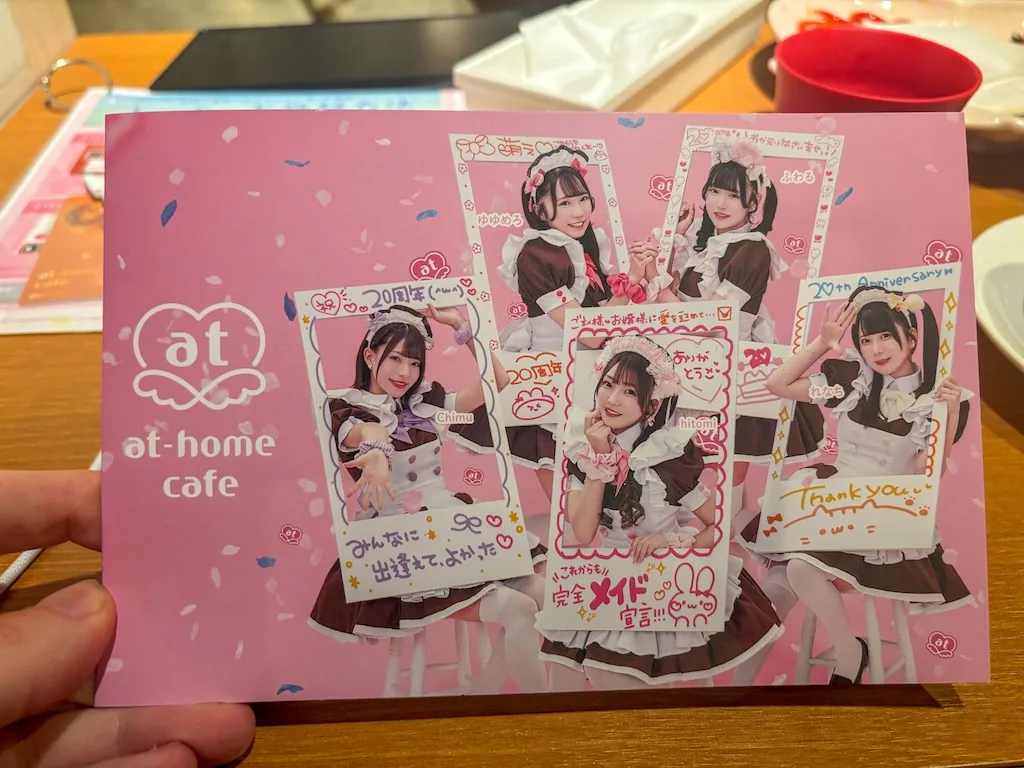
A little later, I received the souvenir album with the photo inside. The picture is quite small, but I think it turned out rather well.
Paying and leaving
Paying afterwards diminished the experience again. きぬ had disappeared somewhere, and I had to tell another maid that I wanted to pay by card. Card payments were accepted, but throughout my visit I had seen everyone else pay only in cash. Classic Japan.
I handed her my card and waited. After a while, another maid came running over to say that they needed my PIN. They had inserted the card’s chip into the terminal rather than swiping it. Once I entered the PIN, I tried to leave, but they sent me back to my seat. It took several more minutes for them to return my card and receipt, and only then could I go.
Conclusion
Visiting a maid café is definitely an experience I would recommend in Akihabara. It is just a shame that a few details made it less enjoyable than it could have been.