The Omega Seamaster Professional 300M that surprised me
I have liked the Omega Seamaster Professional 300M for a long time. Not exactly because James Bond wore one, although it is hard to avoid that connection with this model. More because the watch has a design of its own and does not try to be just another variation on the Rolex Submariner. The wave dial, prominent bezel, skeletonized hands, helium escape valve at ten o’clock and distinctive five-link bracelet make it a watch you recognize immediately.
The problem has always been the size. The current Seamaster Professional is 42 mm. That may not sound extreme on paper, but on my roughly 15 cm wrist it simply does not work. It is not a watch for my wrist.
Omega used to make midsize versions with a diameter of around 36 mm. That is exactly the kind of size that suits me much better. But these smaller Seamasters have been out of production for a long time, so buying one today means looking on the secondary market.
Choosing and buying it
For several years, I occasionally checked Chrono24, Chronomag and other forums. I wanted the classic blue Seamaster with the Bond-watch look. The actual movie watch was always the full-size model, but I was mainly interested in the midsize references 2551.80.00 (automatic) and 2561.80.00 (quartz), which kept the same design in a much more wearable size.
Condition is the problem with older watches. Many examples have heavily polished cases, damaged bezels, unclear service histories or some combination of all three. Good ones obviously exist, but there are not that many midsize examples around, and they often disappear before you have time to make up your mind.
Eventually, I came across reference 2552.80.00. The watch was in good condition and had even been checked on a timegrapher and pressure-tested before the sale, which definitely is not something I take for granted with a watch around 25 years old.
It was not quite what I had in mind, though. This is not the classic Bond configuration with a blue bezel. The bezel has a steel insert with the numerals and markers filled in dark blue. Compared with the classic Bond version, it is much more understated and can look almost grey at first glance.
That was probably why I hesitated. I wanted a blue Seamaster with a blue bezel, and what I bought was a related but visually much less obvious version. At the same time, it was a very good opportunity to buy a midsize Seamaster in the kind of condition you do not come across every day.
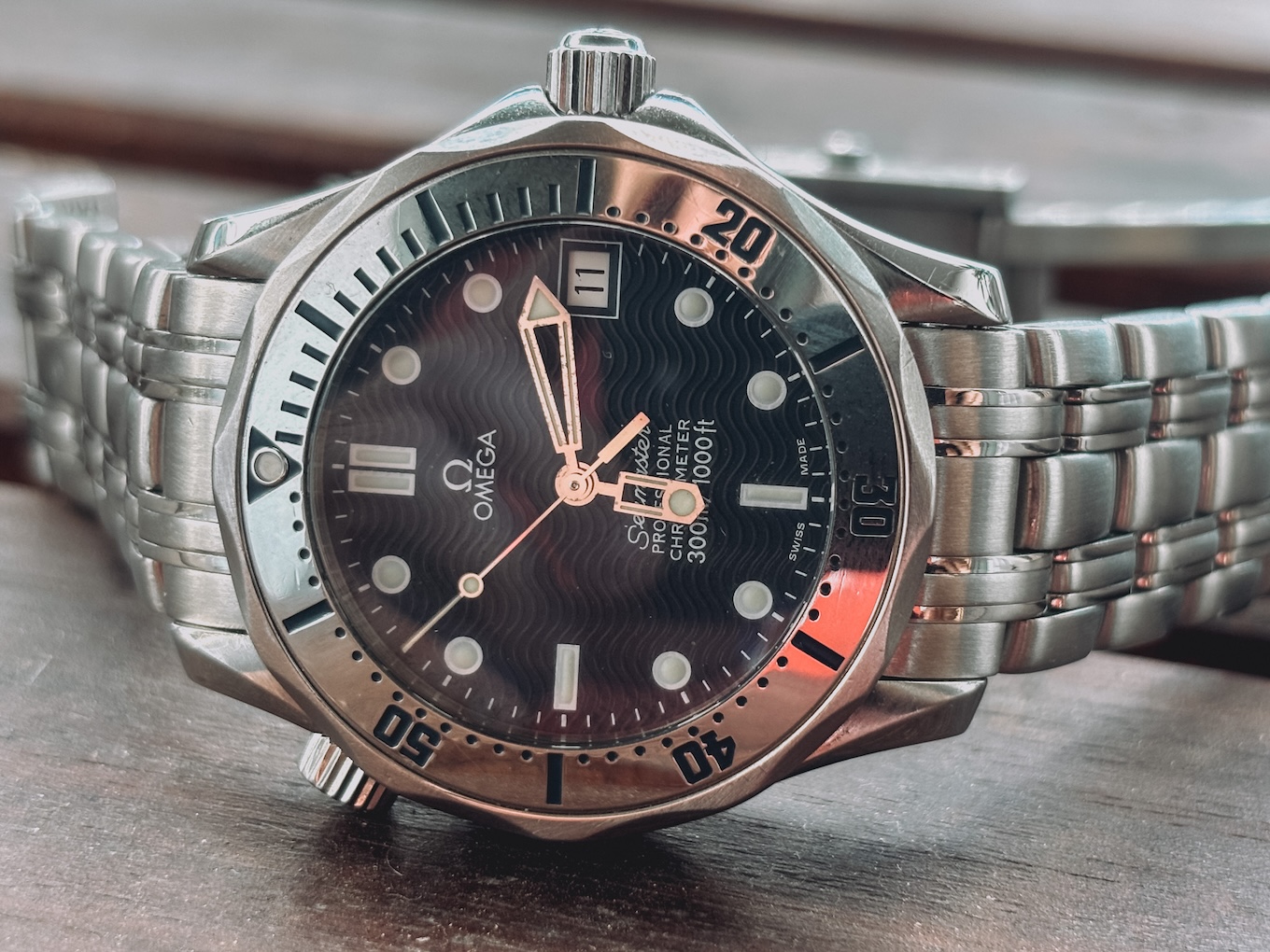
Omega Seamaster Professional 300M midsize
Reference 2552.80.00 is the automatic midsize Seamaster Professional 300M from a period when Omega offered this model in several sizes and configurations. The larger 41 mm version is better known and much more common, but the 36 mm version makes far more sense for my wrist.
The size is a little deceptive. A diameter of around 36 mm is similar on paper to my Tudor Black Bay 36 or a Rolex Oyster Perpetual 36, but the Seamaster feels smaller on the wrist. The relatively wide bezel and smaller dial opening make it look smaller than something like the Rolex Oyster Perpetual 36.
Design
The wave dial is the most distinctive feature. This reference is usually described as blue, but indoors it looks very dark, sometimes almost black. In sunlight, the blue comes through, the wave pattern comes alive and the watch looks much more interesting. This is exactly the kind of detail that is hard to capture in photos but makes a real difference when wearing it.
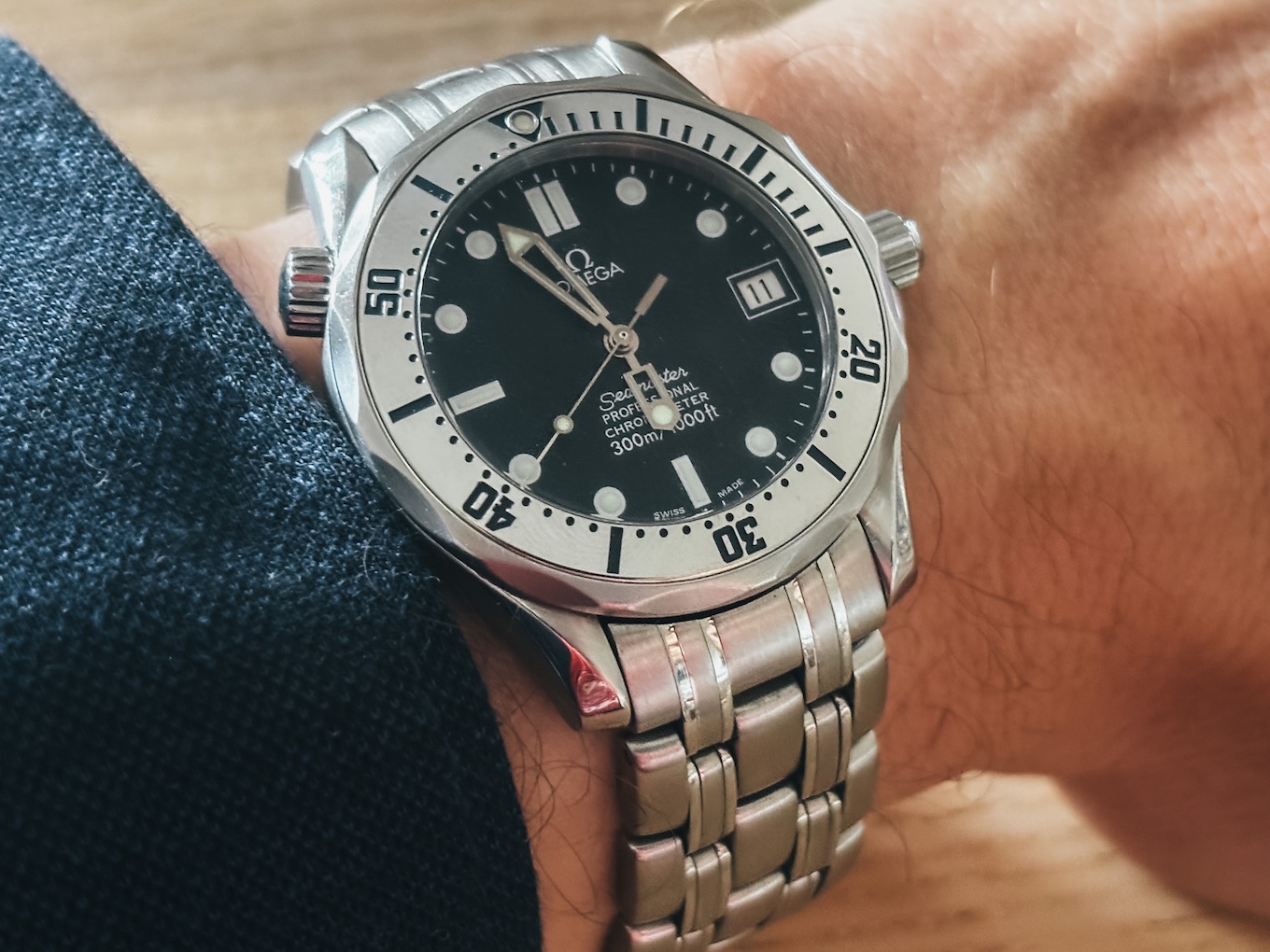
The skeletonized hands are a little odd, but they belong on this watch. The same goes for the indices and the dial typography, which look very much like a product of their time. This is not modern minimalist design. It is a sports watch from the turn of the millennium that has managed to hold on to its identity.
Unlike the Bond version, my reference does not have a blue aluminium bezel insert. Instead, it has a steel insert with the numerals and markers filled in dark blue. This bothered me at first because I had the classic blue Bond-style Seamaster in my head. Gradually, though, I got used to the more understated look. It makes the watch less conspicuous and a little easier to wear every day. It is not the iconic combination of a blue dial and blue bezel, but it has a charm of its own.
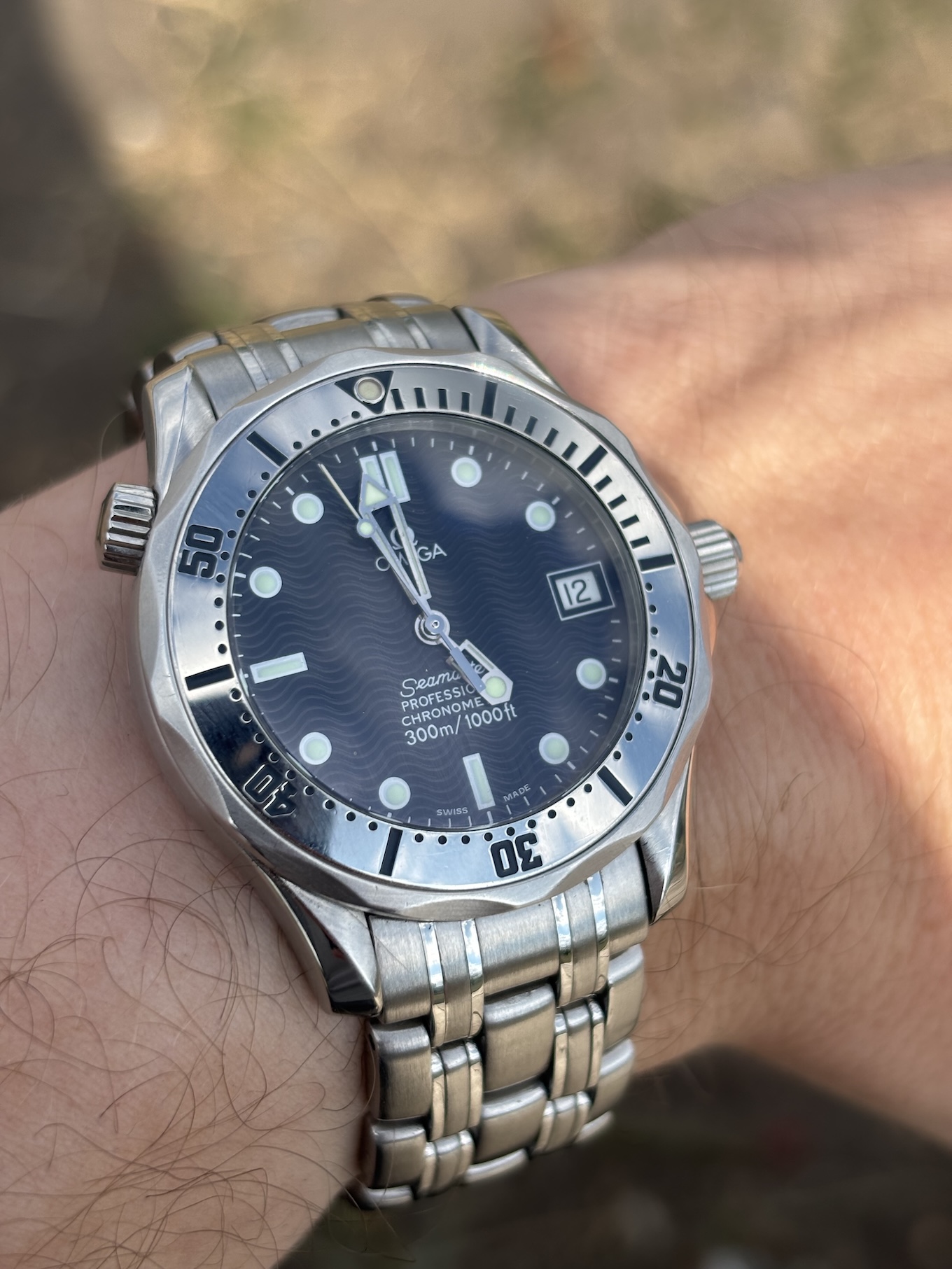
The helium escape valve at ten o’clock is more of a design feature for me than something I will ever use. The same goes for the diving extension in the clasp. These are technical features that belong on a dive watch, but in everyday use they remain little more than curiosities.
Movement
The watch is powered by an automatic Omega chronometer. The calibre most commonly listed for this reference is the 1120. It is an automatic movement with a date, manual winding and hacking seconds, meaning the seconds hand stops when setting the time. The power reserve is around 44 hours and the movement beats at 28,800 vibrations per hour.
My watch loses around six seconds per day, which I think is perfectly fine considering its age. With an older watch, a consistent rate matters more to me than keeping it within a few seconds per day at all costs.
Bracelet
The bracelet was the biggest surprise. In photos, I had always found the Bond bracelet a little odd. The five-link construction with its heavily rounded links does not look as clean as the Oyster bracelet I had grown used to on other watches.
On the wrist, however, it works brilliantly. The rounded links let the bracelet drape very comfortably around the wrist. It feels softer and more comfortable than I expected from its appearance. With a smaller watch, bracelet comfort can make a big difference, and Omega got the shape exactly right here.
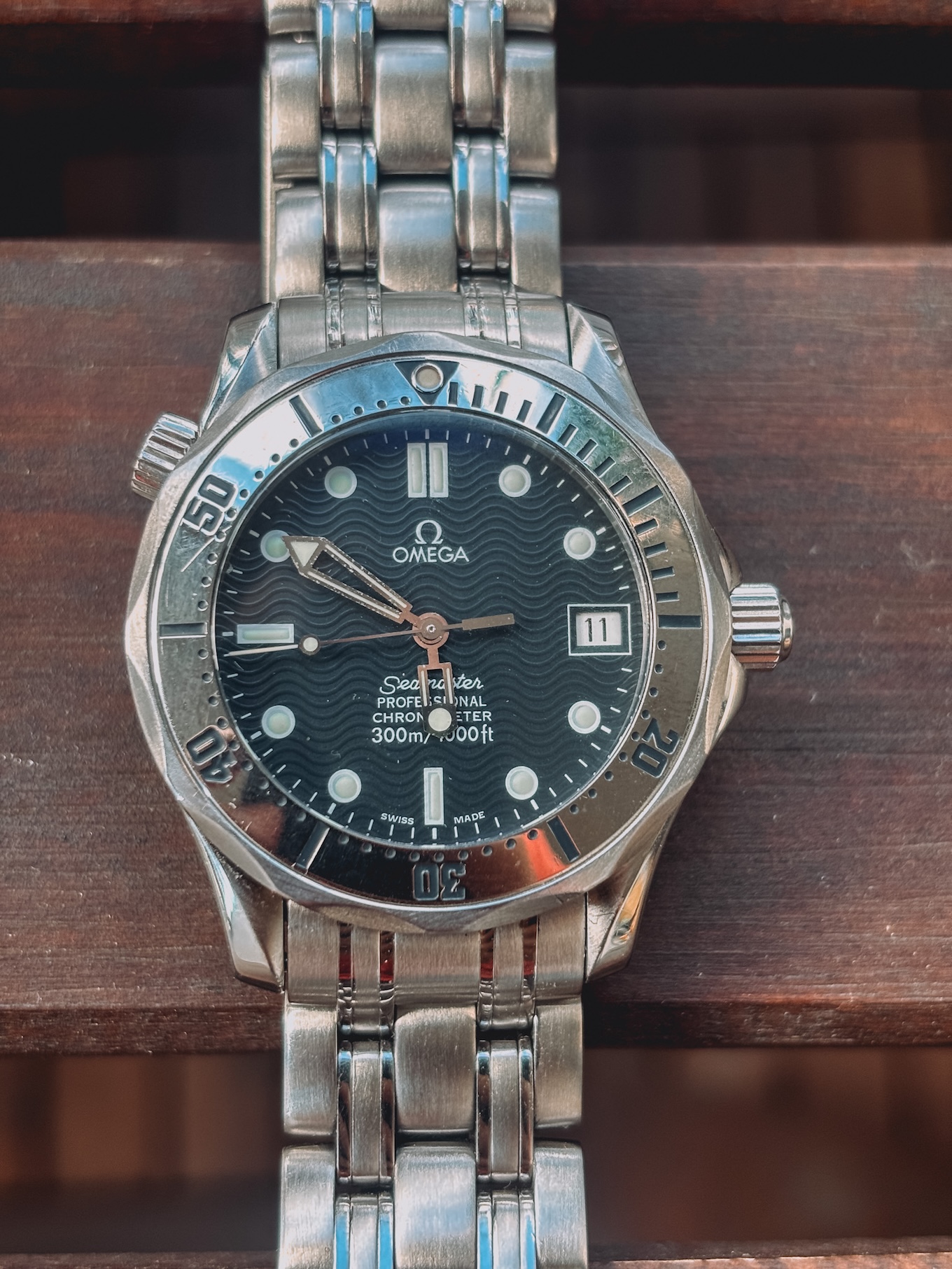
It has its downsides. Sizing it is a pain compared with modern bracelets, and there is no micro-adjustment. On my wrist, getting the fit right often comes down to a matter of millimetres, so I really miss having a micro-adjustment on this watch. Once the length is right, though, it is very comfortable.
On the wrist
My first impressions were honestly a little mixed. I expected more from a watch I had followed for so long. Instead, it felt smaller than I had imagined, it was not as obviously blue as I wanted, and the bracelet was harder to size than what I was used to from newer watches.
After a few days, though, that started to change. The watch is light, comfortable and very well sized for my wrist. It does not have the heft of a modern dive watch. It feels more like a sports watch from a time before every diver needed to be over 42 mm with the chunkiest case possible.
The lume surprised me too. I honestly expected a much worse result. Instead, even after roughly a quarter of a century, it is still perfectly usable.
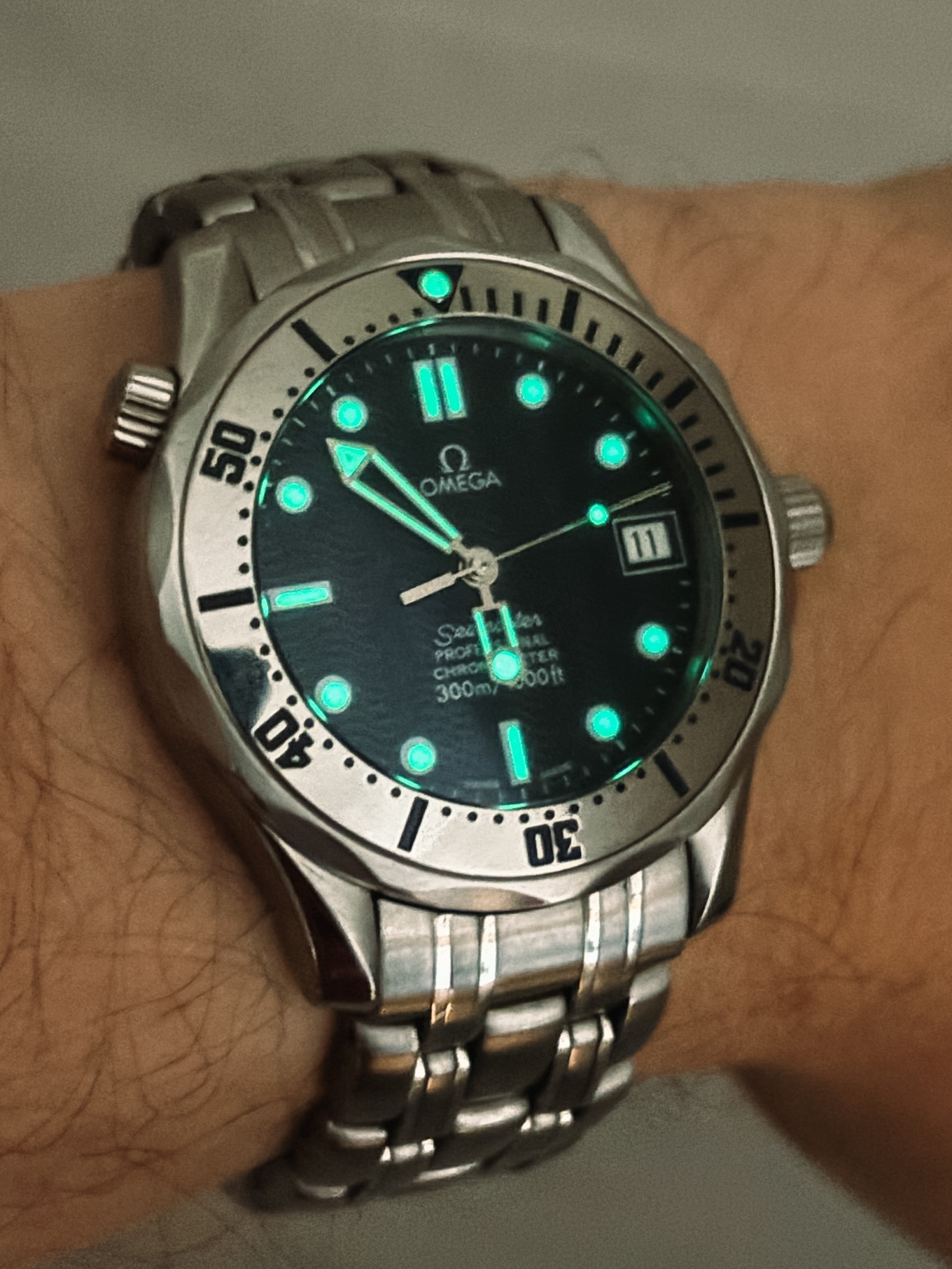
What I like most is that the watch does not feel perfect. Modern Seamasters are objectively better watches. They have more advanced movements, ceramic bezels, better clasps, micro-adjustment and feel more technically advanced overall. But they are also too large and a little too conspicuous for me.
This older midsize Seamaster has its flaws, but it also has personality. The steel bezel, quirky bracelet, helium escape valve, awkward sizing and smaller dimensions made it a watch I had to get to know. It was not love at first wear. I simply warmed to this particular watch over time.
Specifications
| reference | 2552.80.00 |
| case diameter | 36.25 mm |
| case material | steel |
| crystal | sapphire |
| movement type | automatic |
| movement | Omega 1120 |
| power reserve | approximately 44 hours |
| frequency | 28,800 vibrations per hour |
| water resistance | 300 metres |
| lug width | 18 mm |
| bezel | steel insert with dark blue fill |
Conclusion
The Omega Seamaster Professional 300M midsize was not a watch that won me over immediately. For the first few days, I wondered whether I should have waited for the classic blue Bond-style version or simply accepted that the Seamaster was not for me.
Ultimately, though, I am glad I bought it. The fact that it is not perfect makes it more interesting. It is small enough for my wrist, has the classic Seamaster design and carries signs of age that, to my eyes, do it no harm.
If Omega made a Seamaster Professional in a similar size today, I would probably give it serious thought. Since it does not, this older midsize model is probably the best way for me to own a Seamaster that genuinely works on my wrist.
I now understand why older Seamasters still have so many fans. They are not perfect, but there is something about them. And that is exactly why I find myself wearing this one more and more.